
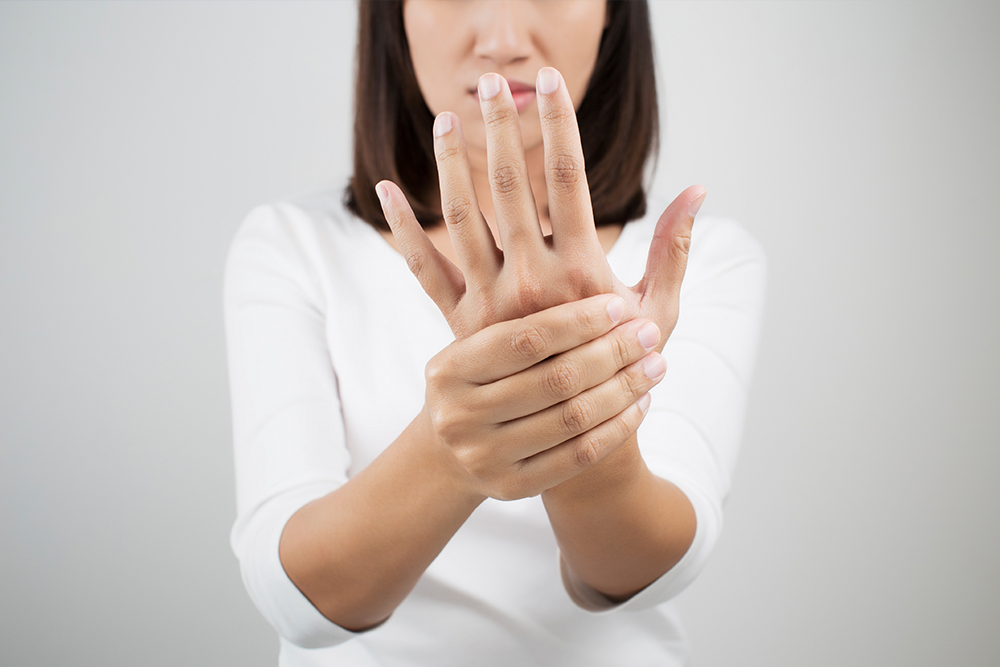
Taking Care of Hand Injuries
By Stephanie Roach, M.D.
We ask a lot of our hands. They are valuable tools for us as we work, play, and go about the activities of daily living. Given the amount of work our hands do every day, it’s no surprise that hand injuries are extremely common.
People injure their hands in a variety of ways. Accidents in the workplace and while doing chores at home (such as mowing the lawn or clearing away snow), and sports injuries are all very common. In addition to traumatic injury, hands often suffer from overuse. Typing, data entry, and repetitive assembly line work can result in painful conditions like carpal tunnel syndrome (nerve compression in the wrist which causes numbness in the fingers) and tendinitis (swelling or irritation of tendons causing pain in the wrist and fingers). Also, as people age, they often develop arthritis. Osteoarthritis (or degenerative arthritis) is most common and usually affects the base of the thumb and the ends of the fingers.
Except in cases of traumatic injury where surgery is required, your doctor will first try to alleviate hand problems through physical therapy, exercise, splinting, and other noninvasive treatment modalities such as ultrasound, massage, and heat therapy. Medication and cortisone injections can help manage pain in arthritic joints and inflamed tendons. However, if these approaches lose their effectiveness to relieve pain and increase function, surgery may be the best course of treatment.
Operating on the hand
The hand is at once very mobile and delicate, which makes hand surgery an exacting discipline. There are many small bones in the hand and wrist, surrounded by tendons and tiny arteries. Sometimes the structures are so small that surgery must be performed under a powerful surgical microscope.
Fortunately, surgery is a field of rapid advancement in research and new technology. One of the latest developments is wrist arthroscopy, which allows the surgeon to look inside the wrist joint with a small camera. This is used to repair ligament tears from traumatic injury or repetitive motion.
Surgeons are also now able to replace and rebuild arthritic joints in the hand. Silicone implants can be used to replace metacarpophalangeal joints destroyed by rheumatoid arthritis. Osteoarthritis most frequently affects the base of the thumb, and surgery to rebuild this joint relieves pain and restores function.
Because surgical repairs are so much stronger now, patients undergoing tendon repair and other hand surgery can begin post-surgical rehabilitation much sooner. With the help of a good hand therapist, these patients can typically return to their usual activities sooner than in the past. The hand therapist employs various techniques to improve the patient’s range of motion by stretching and strengthening the muscles and tendons in the hand and wrist. Custom-made splints are often required during the healing process, as well, which the hand therapist can fit to the surgeon’s specifications. The goal is to speed the healing process and to avoid re-injury.
Traumatic hand injury
Summer boating and lawn-mower accidents can result in the loss of fingertips and entire digits. Generally, when a fingertip is cut off by a boat motor or a lawn mower, the piece is so badly damaged that reattaching it is not a viable option. In these cases the surgeon will simply revise the fingertip. Even in cases of traumatic amputation of an entire finger, reattachment is not always advised unless the injured finger is the thumb: rehabilitation following amputation is long and the results are often disappointing in terms of regaining full function. However, when the accident victim is a child, single finger reattachment is generally recommended because children are more likely to regain full function following surgery than adults having similar surgery are. The difficulty with reattaching the small fingers of children lies in repairing the tiny arteries in their hands. If they are not big enough to see and suture with the aid of a microscope, then reattachment is impossible.
The Tompkins County region has, in its medical community, surgeons and hand therapists who are well trained in the diagnosis and treatment of hand injuries. These practitioners are doing the latest in hand surgery and rehabilitation, and treat hand injuries on a very regular basis.
Dr. Roach is a board certified orthopedic surgeon on staff at Cayuga Medical Center. She has specialized training in hand surgery and is in practice with Ithaca Orthopaedic Group, where she can be reached at (607) 266-0073.


Related News

what our patients are saying
“I have been a Hemo dialysis patient for almost Five years. Prior to dialysis and during dialysis I have had several trips to the ER, due to other health issues & was admitted to CMC more than a few times. Each and every time I’ve been there, whether in patient or out, I have been treated with respect, professionalism, and efficiency. I give this hospital 2 thumbs up!! Thank you CMC for taking care of me all these years!!”
“The staff and accommodations at Cayuga Birthplace are amazing!!! This is what it I imagine it would feel like to be a celebrity getting VIP treatment. I wish I could stay longer – even the food options are 5 Star! The amenities are great. Everything is clean and designed beautifully. Not a single complaint, only praises!”
“I have had many occasions visiting CMC for myself and family. We have never had a bad experience there at all. Last October I had surgery and the nurses were amazing especially my night nurse. Thank you to all CMC staff for doing what you do every day with a smile.”
“I have to say the last couple visits that I’ve had here have been wonderful. About a month ago I had an EGD and the staff were amazing! Explained everything in detail and made me feel at ease. I was very nervous and the nurse I had was very comforting. Tonight we had to take my son to the emergency room and they were awesome with him! We got right in. “