Diversity, Equity & Inclusion
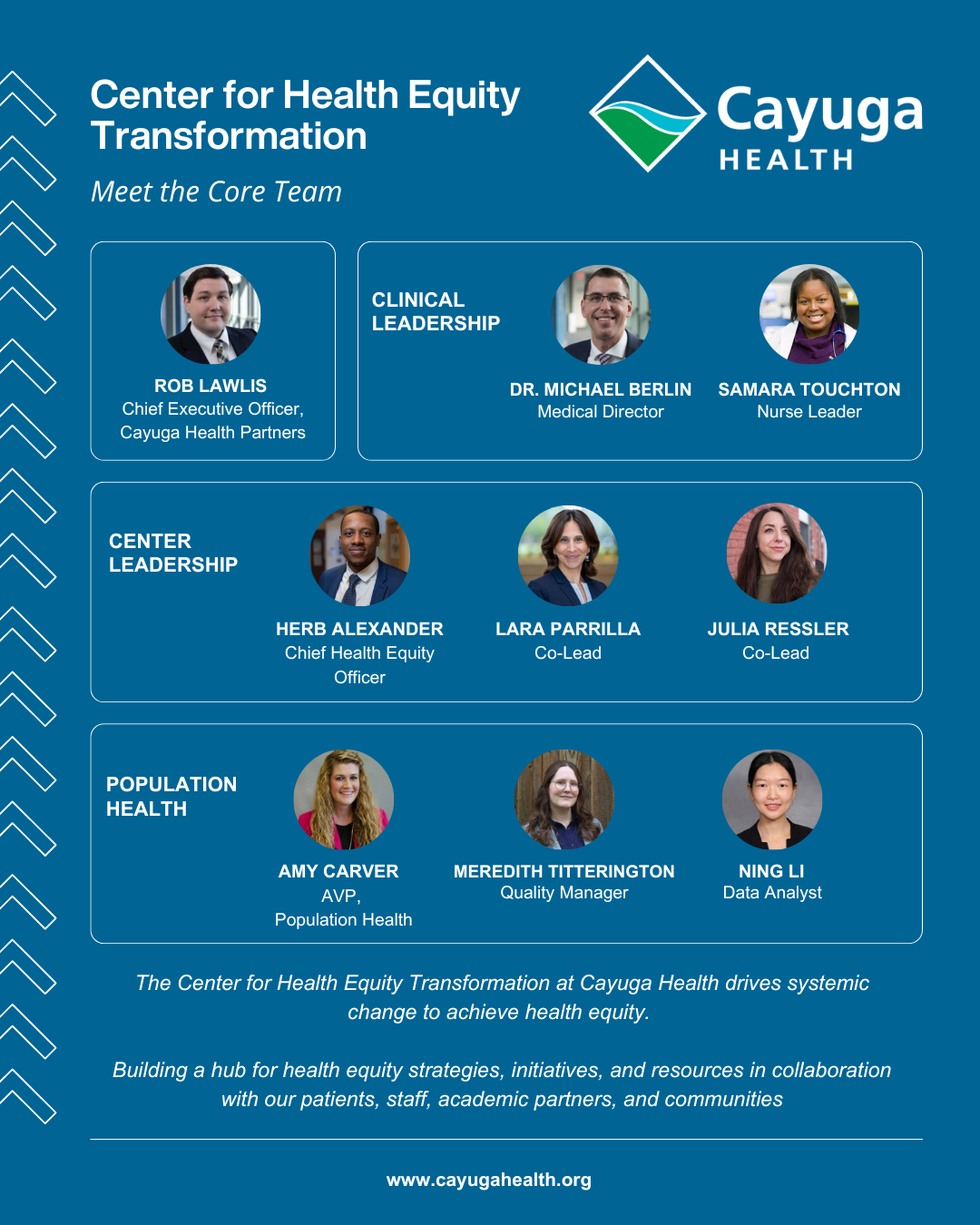
Center for Health Equity Transformation
At Cayuga Health, we believe everyone deserves the chance to be as healthy as possible. We are on a mission to improve health equity in all of the communities it serves across the Southern Tier of New York State. The Center for Health Equity Transformation is a virtual hub for health equity strategies and resources for coordinated, collaborative initiatives.
The Center will drive systemic change, strengthen community and academic partnerships, and transform policies and practices in order to eliminate disparities and barriers for marginalized populations and support a vibrant, healthy, and equitable community for all.
Health Equity Dashboard
This health equity dashboard shares information about where we are on our journey to improve health equity, including the quality of care we provide and the health outcomes in our communities. This data snapshot helps us to understand where we are and what we need to do next.
We highlight focus areas chosen based on our Community Health Assessments and Improvement Plans. For each focus area, we track our progress over time and highlight some of the work Cayuga Health and community partners are doing to make improvements.
This is the first version of this public health equity dashboard. Data will be updated on a regular basis, and we hope you will join us in continuously improving the way we collect, understand, and share this information.
It's all about our mission to improve health equity. We look forward to working with you on this journey to make our community healthier, together.
Cancer Screening
Getting cancer screening tests regularly may find breast, cervical, and colorectal (colon) cancers early, when it’s easier to treat and treatment is likely to work best.

- Percent of all patients aged 45-75 years eligible for colorectal cancer screening who were seen at any Cayuga Health location and had an up-to-date screening for colorectal cancer in 2023.
- Percent of all patients aged 45-75 years eligible for colorectal cancer screening who have a primary care provider or gastroenterologist at Cayuga Health and had an up-to-date screening for colorectal cancer in 2023.
- Percent of adults aged 50-75 years eligible for colorectal cancer screening in Tompkins, Schuyler, and Cortland counties who reported having an up-to-date screening by way of the Behavioral Risk Factor Surveillance System Survey.
- A note on stratifying data and understanding health disparities: Stratifying quality data by patient race, ethnicity, language and other demographic factors such as age, sex, health literacy, sexual orientation, gender identity, socio-economic status, and geography is an important tool for identifying and addressing healthcare disparities. Unless specifically measured, disparities in health and healthcare can go unnoticed, even as we seek to improve care. It is important to consider a health equity lens, which defines health disparities not solely as differences in healthcare quality or health outcomes. Underlying these differences are historical and structural factors, racism and other forms of oppression, intentional or unintentional discrimination or marginalization, and all of the related impacts.
- Percent of Asian patients aged 45-75 years eligible for colorectal cancer screening who have a primary care provider or gastroenterologist at Cayuga Health and had an up-to-date screening for colorectal cancer in 2023.
- Percent of Black patients aged 45-75 years eligible for colorectal cancer screening who have a primary care provider or gastroenterologist at Cayuga Health and had an up-to-date screening for colorectal cancer in 2023.
- Percent of White patients aged 45-75 years eligible for colorectal cancer screening who have a primary care provider or gastroenterologist at Cayuga Health and had an up-to-date screening for colorectal cancer in 2023.
Additional Notes
- Click here for indicator definition
- Data are suppressed if fewer than 50 respondents are in a specific category, such as sex, race, or ethnicity.
- Prevalence is the measured or estimated percentage of people with an attribute or disease during a specific time period.
- Age-adjusted prevalence is standardized by direct method to the age distribution of the U.S. 2000 standard million population.
Source: U.S. Cancer Statistics Working Group. U.S. Cancer Statistics Data Visualizations Tool. U.S. Department of Health and Human Services, Centers for Disease Control and Prevention and National Cancer Institute; https://www.cdc.gov/cancer/dataviz, June 2024.
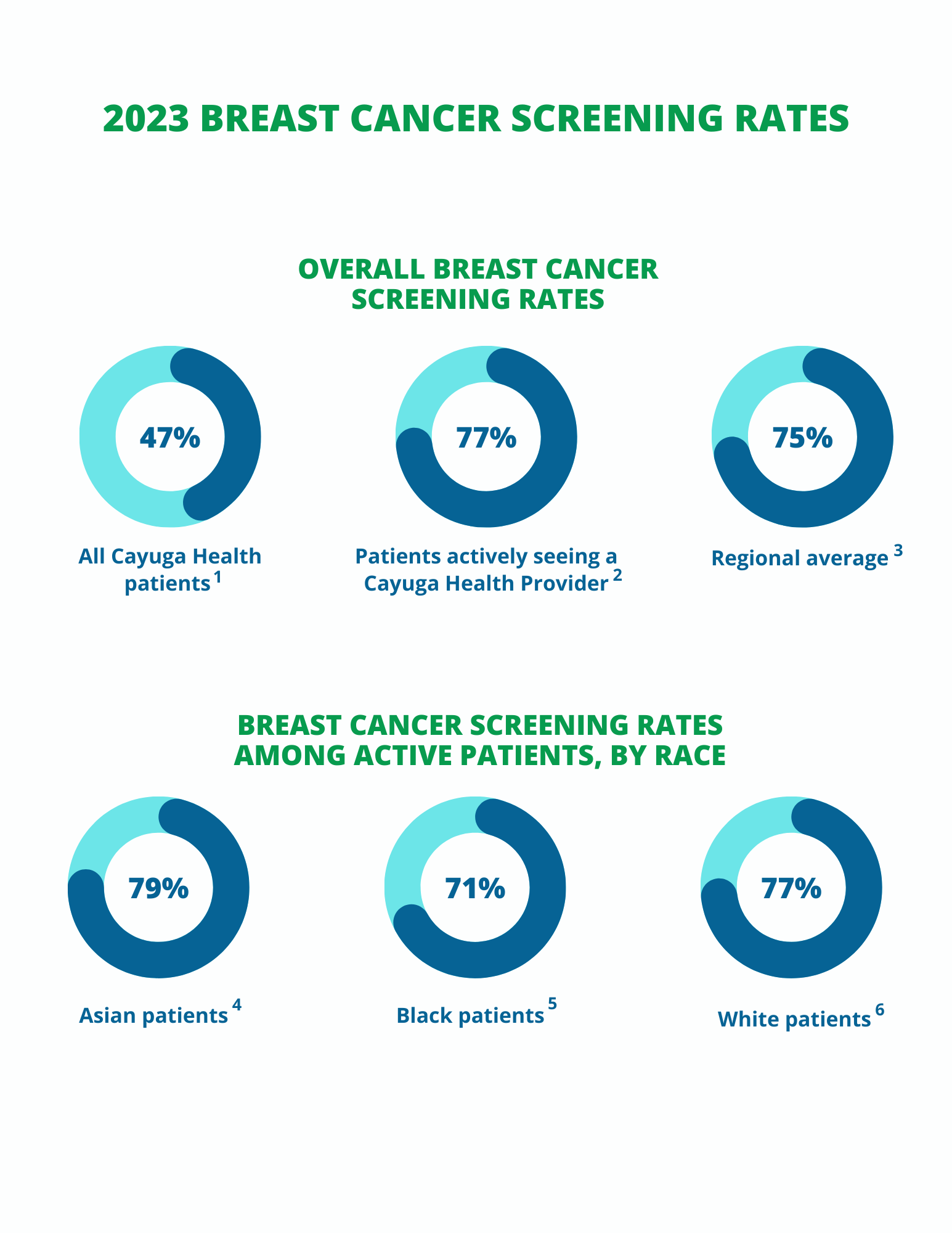
- Percent of all patients aged 50-74 years eligible for breast cancer screening who were seen at any Cayuga Health location and had an up-to-date screening for breast cancer in 2023.
- Percent of all patients aged 50-74 years eligible for breast cancer screening who have a primary care provider or gynecologist at Cayuga Health and had an up-to-date screening for breast cancer in 2023.
- Percent of adults aged 50-74 years eligible for breast cancer screening in Tompkins, Schuyler, and Cortland counties who reported having an up-to-date screening by way of the Behavioral Risk Factor Surveillance System Survey.
- Percent of Asian patients aged 50-74 years eligible for breast cancer screening who have a primary care provider or gynecologist at Cayuga Health and had an up-to-date screening for breast cancer in 2023.
- Percent of Black patients aged 50-74 years eligible for breast cancer screening who have a primary care provider or gynecologist at Cayuga Health and had an up-to-date screening for breast cancer in 2023.
- Percent of White patients aged 50-74 years eligible for breast cancer screening who have a primary care provider or gynecologist at Cayuga Health and had an up-to-date screening for breast cancer in 2023.
Additional Notes
- Click here for indicator definition
- Data are suppressed if fewer than 50 respondents are in a specific category, such as sex, race, or ethnicity.
- Prevalence is the measured or estimated percentage of people with an attribute or disease during a specific time period.
- Age-adjusted prevalence is standardized by direct method to the age distribution of the U.S. 2000 standard million population.
Source: U.S. Cancer Statistics Working Group. U.S. Cancer Statistics Data Visualizations Tool. U.S. Department of Health and Human Services, Centers for Disease Control and Prevention and National Cancer Institute; https://www.cdc.gov/cancer/dataviz, June 2024.

- Percent of all patients aged 21-64 years eligible for cervical cancer screening who were seen at any Cayuga Health location and had an up-to-date screening for cervical cancer in 2023.
- Percent of all patients aged 21-64 years eligible for cervical cancer screening who have a primary care provider or gynecologist at Cayuga Health and had an up-to-date screening for cervical cancer in 2023.
- Percent of adults aged 21-65 years eligible for cervical cancer screening in Tompkins, Schuyler, and Cortland counties who reported having an up-to-date screening by way of the Behavioral Risk Factor Surveillance System Survey.
- Percent of Asian patients aged 21-64 years eligible for cervical cancer screening who have a primary care provider or gynecologist at Cayuga Health and had an up-to-date screening for cervical cancer in 2023.
- Percent of Black patients aged 21-64 years eligible for cervical cancer screening who were seen at any Cayuga Health location in the last two years and had an up-to-date screening for cervical cancer in 2023.
- Percent of White patients aged 21-64 years eligible for cervical cancer screening who have a primary care provider or gynecologist at Cayuga Health and had an up-to-date screening for cervical cancer in 2023.
Additional Notes
- Click here for indicator definition
- Data are suppressed if fewer than 50 respondents are in a specific category, such as sex, race, or ethnicity.
- Prevalence is the measured or estimated percentage of people with an attribute or disease during a specific time period.
- Age-adjusted prevalence is standardized by direct method to the age distribution of the U.S. 2000 standard million population.
Source: U.S. Cancer Statistics Working Group. U.S. Cancer Statistics Data Visualizations Tool. U.S. Department of Health and Human Services, Centers for Disease Control and Prevention and National Cancer Institute; https://www.cdc.gov/cancer/dataviz, June 2024.
Ongoing Efforts in the Community to Improve Cancer Screening
In collaboration with community partners including the Cancer Services Program, Cancer Resource Center of the Finger Lakes, and Human Services Coalition, Cayuga Health makes Saturday mammography screening appointments available every fall in Tompkins, Schuyler, and Cortland counties.
In collaboration with community partners including Calvary Baptist Church, Loaves & Fishes, Cancer Services Program, Cancer Resource Center of the Finger Lakes, and the Human Services Coalition), are distributing free FIT tests for colorectal cancer screening at home.
Cayuga Health has translated patient education materials distributed by the Cayuga Cancer Center, adding at least 5 languages to the print materials most utilized by patients.
Cayuga Health Partners distributes performance report cards to clinical providers to assess the percentage of patients who are eligible for screening and who have completed their screening.
Management of Diabetes
A hemoglobin A1c test is a blood test that is used to check a person’s average blood sugar level. Regular monitoring of hemoglobin A1c levels can detect diabetes early, help manage diabetes over time, and reduce the risk of complications. Cayuga Health also monitor hemoglobin A1c levels among our patient population with diabetes to see how well we are supporting patients in managing their average blood sugar level.

- Percent of adult patients aged 18-75 years with diabetes seen at any Cayuga Health location whose average blood sugar level was less than 8.
- Percent of patients aged 18-75 years with diabetes who have a primary care provider or endocrinologist at Cayuga Health and whose average blood sugar level was less than 8.
- Percent of Asian patients aged 18-75 years with diabetes who have a primary care provider or endocrinologist at Cayuga Health and whose average blood sugar level was less than 8.
- Percent of Black patients aged 18-75 years with diabetes who have a primary care provider or endocrinologist at Cayuga Health and whose average blood sugar level was less than 8.
- Percent of White patients aged 18-75 years with diabetes who have a primary care provider or endocrinologist at Cayuga Health and whose average blood sugar level was less than 8.
Regional average not available for this indicator.
Additional Notes
- Click here for indicator definition
- Data are suppressed if fewer than 50 respondents are in a specific category, such as sex, race, or ethnicity.
- Prevalence is the measured or estimated percentage of people with an attribute or disease during a specific time period.
- Age-adjusted prevalence is standardized by direct method to the age distribution of the U.S. 2000 standard million population.
Ongoing Efforts in the Community for the Management of Diabetes
Cayuga Health, in collaboration with community partners, coordinates community-based health screening and navigation events every month at different locations throughout our community to improve early detection of pre-diabetes and cardiovascular disease and improve access to care.
Our partners have included Calvary Baptist Church, Cornell Cooperative Extension of Tompkins County, Food Bank of the Southern Tier, Human Services Coalition, Latino Civic Association, Loaves & Fishes, Southside Community Center, Tompkins County Office for the Aging, Tompkins County Whole Health, and YMCA of Ithaca and Tompkins County.
Our events can include:
- Pre-diabetes risk assessment
- Point-of-care HbA1c testing
- Medical questions and answers
- Navigation to resources that address health-related social needs and support program enrollment
- Primary care appointment scheduling
Access to Postpartum Care
Every person’s experience with postpartum recovery is different, and it’s important to have open communication with healthcare providers during this time.

- Percent of patients seen at any Cayuga Health location who had a postpartum follow up care visit within 84 days of delivery.
- Percent of patients who have a Cayuga Health primary care provider or obstetrics provider who had a postpartum follow up care visit within 84 days of delivery.
- Percent of Hispanic or Latino patients (of any race) who had a postpartum follow up care visit within 84 days of delivery.
- Percent of non-Hispanic or Latino patients (of any race) who had a postpartum follow up care visit within 84 days of delivery.
*Regional average not available for this indicator.
Additional Notes
- Click here for indicator definition
- Data are suppressed if fewer than 50 respondents are in a specific category, such as sex, race, and ethnicity.
- Prevalence is the measured or estimated percentage of people with an attribute or disease during a specific time- period.
- Age-adjusted prevalence is standardized by direct method to the age distribution of the U.S. 2000 standard million population.
Ongoing Efforts in the Community to Improve Access to Postpartum Care
The Healthy Infants Partnership of Tompkins County (HiP Tompkins) connects families with a Community Health Worker (CHW) to improve the overall health and well-being of mothers, pregnant or birthing people, and their infants. HiP CHWs work one on one with clients to ensure they are aware of community services, and that they have the knowledge and skills to seek out and receive needed care and services. HiP CHWs make referrals and coordinate care to improve the health outcomes of their clients.
Cayuga Health is facilitating improvements in patient demographic data collection at Cayuga Health and 42 outpatient practices via the “We Ask Because We Care” campaign, improving Cayuga Health’s ability to identify and address disparities in maternal and child health outcomes.
Cayuga Birthplace is working with Cornell Public Health on a quality improvement initiative for their lactation education program, which aims to proactively promote, protect, and support breastfeeding.
U.S. Cancer Statistics Working Group. U.S. Cancer Statistics Data Visualizations Tool. U.S. Department of Health and Human Services, Centers for Disease Control and Prevention and National Cancer Institute; https://www.cdc.gov/cancer/dataviz, released in June 2024.