
Body
Breast
Breast augmentation can be a tremendous confidence builder in many women who either never developed full breasts, or have had decrease in size of their breasts following pregnancy or weight loss. Breast augmentation can safely fill out the breasts and allow these women to wear clothing that they may not otherwise feel comfortable wearing. Implants also may be used to reconstruct a breast after mastectomy or injury.
After the incision is made, a breast implant is inserted into a pocket either:
- Under the pectoral muscle (a submuscular placement), or
- Directly behind the breast tissue, over the pectoral muscle (a submammary / subglandular placement)
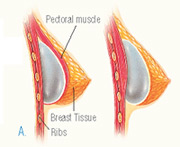
The method for inserting and positioning implants depends on the type of implant, degree of enlargement desired, your body type, and your surgeon’s recommendations.
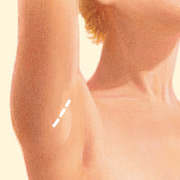
There are three commonly used incision methods
- Inframammary incision, in the fold where the bottom edge of the breast meets the chest.
- Periareolar incision, around the lower edge of the areola, where the darker skin surrounding the nipple meets the lighter skin of the breast.
- Transaxillary incision, small incision made in the armpit crease for breast augmentation.


Also known as mastopexy, a breast lift raises and firms the breasts by removing excess skin and tightening the surrounding tissue to reshape and support the new breast contour. Breast lifts are often done as an isolated procedure, but also as a frequent adjunct to breast augmentation surgeries.
Sometimes the areola becomes enlarged over time, and a breast lift will reduce this as well. A breast lift can rejuvenate your figure with a breast profile that is youthful and uplifted.
Breast reconstruction is achieved through several plastic surgery techniques that attempt to restore a breast to near normal shape, appearance and size following mastectomy.
Breast reconstruction is a physically and emotionally rewarding procedure for a woman who has lost a breast due to cancer or other condition.
The creation of a new breast can dramatically improve your self-image, self-confidence and quality of life. Although surgery can give you a relatively natural-looking breast, a reconstructed breast will never look or feel exactly the same as the breast that was removed.
Types of Breast Reconstruction:
- Tissue Expander/Implant Reconstruction
- A permanent implant can sometimes be placed immediately at the time of the mastectomy, however reconstruction with an implant often requires tissue expansion. Tissue expansion stretches healthy skin to provide coverage for a breast implant. Reconstruction with tissue expansion frequently allows a faster and easier recovery than flap procedures, but it is sometimes a more lengthy reconstruction process.It typically requires several office visits over 2-3 months after placement of the expander to gradually fill the device through an internal valve to expand the skin. A second surgical procedure will be needed to replace the expander with a permanent implant.Surgical placement of a breast implant creates a breast mound. Secondary procedures are often done to further improve shape and symmetry and to create a new nipple and areola.
- Flap Reconstruction
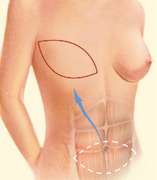
- TRAM Flap
- TRAM is short for transverse rectus abdominis muscle, which is a muscle in the lower abdomen between your waist and pubic bone. A flap of this skin, fat, and muscle are used to reconstruct the breast in a TRAM flap breast procedure.TRAM flaps are commonly performed, due to TRAM flap tissue being natural living tissue which feels quite similar to breast tissue — making a good substitute.
- TRAM Flap
-
- Latissimus Dorsi Flap
- A latissimus dorsi flap uses muscle, fat and skin from the back tunneled to the mastectomy site. In some cases the the flap is used alone to cover a mastectomy defect, but an implant is often used underneath the flap to reconstruct an adequate size breast mound. In contrast, implants are typically not necessary with TRAM flaps to create a full size breast mound.
- Latissimus Dorsi Flap
- Nipple and areolar reconstruction
- Minor outpatient procedures where a small skin flap is done to create the raised nipple and then medical tattooing is done to create the darker pigmentation of the nipple and areola.
All of these procedures are typically covered under health insurance.
Female Brest Reduction:
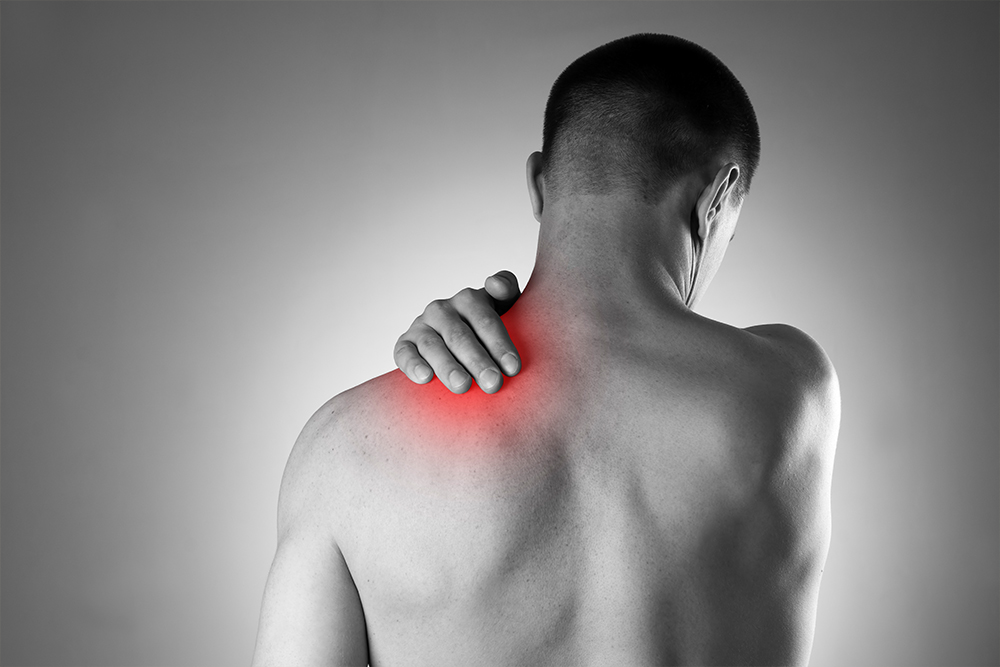
Excessively large breasts can result in significant physical and emotional issues. Many women suffer from chronic neck, back and shoulder pain from overly large breasts. The emotional discomfort and self-consciousness that can be associated with large breasts can be just as troubling.
Breast reduction, also known as reduction mammaplasty, is a procedure to remove excess breast fat, glandular tissue and skin to achieve a breast size in proportion with your body and to alleviate the discomfort associated with overly large breasts.
Breast reduction always involves a breast lift. The incision patterns are basically identical; see the Breast Lift section above for more details on the incisions used. However, in addition to skin tightening and lifting the nipple and breast tissue, significant weight is removed from the breasts to make them lighter and smaller.
Breast reduction patients are some of our happiest patients because they frequently feel immediate relief in their neck, back and shoulders, and they find it easier to be more active, and can fit into clothing better.
Male Breast Reduction:
Gynecomastia is common condition in adolescent and adult men, where the breasts are excessively large. This can result in significant social discomfort, as well physical complaints related to tenderness in the breasts. It is frequently treated by liposuction to remove fatty tissue from the breasts as well as direct surgical excision of breast tissue. In occasional cases, a second surgery may be needed to remove excess skin and tighten the breasts.
Face
Latest News






















































































































































































































































































what our patients are saying

“I’ve got more hope now.”